


The STEEPLE analysis helps us identify the various internal and external elements that could have an effect on our company’s operations and human resources department.
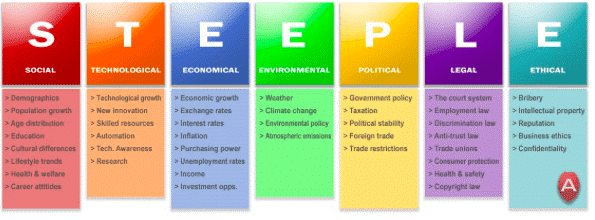
STEEPLE analysis
Because of its effect on the organization’s human capital, politics is a key factor influencing company operations and HR practices. The Brexit is a prime illustration. Leaving the EU meant that Britain had to untangle its legislative and executive regulatory structure, which was a daunting process. Business has been impacted by Brexit in the short term due to the shift in legal standpoint it represents (Bloom et al, 2019). This can only happen if the applicable EU law is translated into UK law, and if the UK courts opt to follow the precedent set by the European Court of Justice. This has caused confusion among business owners and employees in the UK as they try to ascertain how the new regulations would impact their contracts and workforce (Bloom et al, 2019). The tightening of the UK labor market due to both changes in employment law and Brexit has made it challenging for businesses across a wide range of industries to fill unfilled positions. As it has grown more challenging to find qualified candidates to fill open positions, human resources departments have adopted innovative practices to increase employee retention (Bloom et al, 2018).These strategies have included an increase in salaries and benefits, in house trainings and promotions equipping the workforce enough to take on responsibilities when a role is left vacant.

Social factors also highly impact a business and its HR functions for instance cultural trends, demographics, and population analytics. For instance the wide adoption of social media as a mode of communication has widely impacted how the HR performs their duties. For instance social media is a great platform for an organisation to build its brand image (Alkhateeb, 2020). With sites like indeed and glassdoor where employees can rate their experience with their employers, it how potential candidates view the organisation while considering application. On sites like linked in HR are also able to interact with a pool of potential employees as well as advertise vacant positions to a large audience of potential employees. Additionally, social media has become a new platform for employee action (Ruparel et al. 2020), as employees are venting injustices they receive from their employers in social media including being overworked and underpaid, and discriminations this has a higher potential of destroying the organisation’s image hence HR must ensure that such factors are kept in check.
Environmental factors like Covid-19 highly impacted organisation and the HR especially since it was their responsible for ensuring that while they remained productive their employees were also safe. Due to government lockout policies, many businesses adopted remote work solutions. Additionally as a result of this interruption in business and the inability to pay operating expenses and personnel salaries, some businesses were forced to implement temporary or permanent closures or employee layoffs (Bloom et al., 2020).
Because part of HR’s job is making sure that businesses follow the law, any changes in the legislation have a significant effect on HR. For instance, the United Kingdom’s IR35 law, that took effect in 2021. Concerns about people providing their services through a limited liability company (Ltd. Co.) to avoid paying employee income tax and national insurance contributions led to its development in 2000 (Markwick, 2019). As a result, the law mandates that businesses exercise “due care” while determining whether or not positions fall within IR35. Therefore, because of the severity of the consequences that could result from taking the wrong actions, it’s crucial that HR departments have access to the resources they need to manage risk while taking full advantage of the benefits of a contractor workforce (Morrison, 2019).