



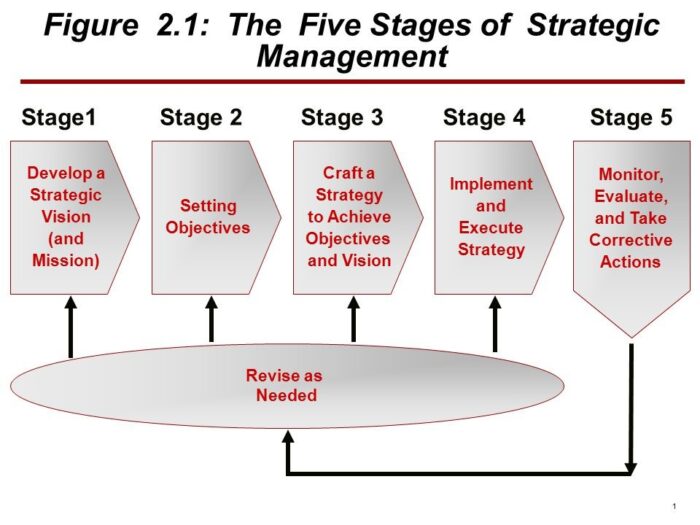
key stages of business strategic Management
Clarify Your Vision
The purpose of goal-setting is to clarify your company’s vision. These objectives ought to be detailed, practical, and align with the vision’s values. This stage entails recognizing three crucial aspects: First, establish both short- and long-term goals. Second, determine how you intend to achieve your goal. Finally, personalize the process for your team; assign each employee a task that he or she can effectively accomplish (Fenech et al., 2019). This position is primarily performed by the HR department, which makes sure that both the employees and the employers understand the strategy. This necessitates effective communication between the human resources and stakeholders. Typically, the last step in this phase is to create a mission statement that concisely explains your objectives to both your Personnel and the shareholders.
Gather and Analyse Information
Analysis is an important stage since the knowledge acquired during this stage will influence the following two stages. During this phase of the process, it is important to collect as much data and information as possible that is pertinent to realizing your vision. The primary goals of the analysis should be to gain an understanding of the requirements of the company as a sustainable entity, the company’s strategic direction, and the identification of initiatives that will assist in the expansion of the company (Sara et al., 2021). At this stage, HR supports in completing the SWOT analysis in order to uncover any internal or external challenges that may have an impact on the strategy’s aims and objectives (Abbasi, 2020). They ensure that both the organization’s strengths and weaknesses, as well as any risks and opportunities that may occur along the way, are identified.

Formulate a Strategy
The first stage in developing a strategy is to go over the information obtained from the analysis (Abbasi, 2020). Determine what resources are currently available to the company that could be used to help achieve the goals and objectives that have been specified. For example, HR may need to hire external labour or train internal employees in order to adequately equip human resources for strategy execution (Abbasi, 2020). Determine whether or not there are any areas in which the company needs to seek resources externally. The company’s challenges ought to be ranked in terms of how crucial they are to the firm’s success. Begin developing the approach once the priorities have been determined. Considering the ever-changing nature of business and economic conditions, it is essential at this point to create a variety of strategies to tackle each component of the plan.
Implement Your Strategy
Implementing the strategy effectively is one of the most important factors determining whether or not the business will be successful. This point in the process of strategic management is referred to as the action stage (Abbasi, 2020). In the event that the current structure of the company is incompatible with the overall plan, then the first step of this stage should involve the implementation of a new structure. It is imperative that every member of the organization is aware of their specific roles and responsibilities, as well as how they contribute to the organization’s overarching mission (Sara et al., 2020). HR also helps with strategy execution in other ways. It can assist the corporation in carrying out restructuring and downsizing activities without upsetting employees, for instance, through connecting rewards to performance, outpacing employees, lowering welfare expenses, and retraining staff.
Evaluate and Control
Performance measurements, regular reviews of internal and external challenges, and taking remedial action when necessary are all parts of the strategy evaluation and control process. The establishment of the measurement criteria is the first step in any effective plan evaluation (Fenech et al., 2019). These parameters should reflect the objectives established in Stage 1. Measure progress by comparing actual results to the plan. Monitoring both internal and external issues equips the organisations with the ability to respond to any significant shifts in the environment in which the business operates. However, if it turns out that the strategy is not getting the company closer to its objective, then the company needs to adjust its course (Sara et al., 2020). In the event that these measures don’t yield the desired results, the strategic management process will need to be re-launched. Because both internal and external issues are in a state of constant flux, any data gained during this stage should be kept for use in the development of any future strategies. The Human Resources department plays a significant part in this stage of the process, and one of their responsibilities is to assess how the workforce feels about the recently implemented strategy (Sara et al., 2020). As part of their contribution to the performance evaluation, they can also highlight both the areas in which they were successful and those in which they could use some improvement.