


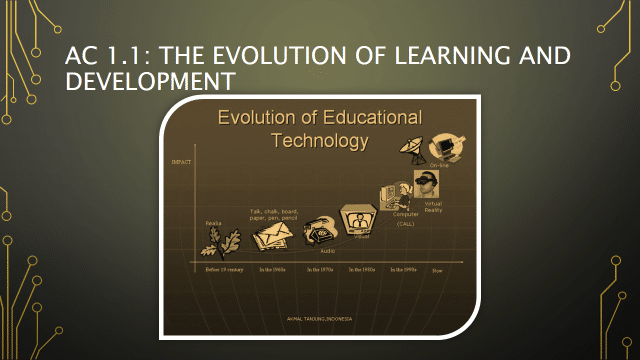
Organisations are now embracing e-learning which is suitable for the new ways of work including remote and hybrid-working (Mukherjee & Nath, 2016). With E-leaning employees can access learning and training through e-resources. They can access webinars and resources online. For instance as a fully online CIPD learner I am able to access learning materials online, attend lecturers, complete my assessments and receive my results remotely through e-learning. Virtual reality has also taken over learning and development as employees are able to recreate real life settings and simulate work challenges (Mukherjee & Nath, 2016). In order to compute, aggregate, and discover the knowledge gaps in an individual’s knowledge, L&D is currently embracing AI (Mukherjee & Nath, 2016). This knowledge is then employed to develop a learner’s profile and enhance overall learning experience.

Learning management systems (LMS) and learning experience platforms have improved learning and development efficiency (LXP).
An LMS is a piece of software that houses, distributes, and tracks training materials (Oliveira, et al., 2016). It offers the framework for managing every part of the learning process. LMS is advantageous to the organization because it provides consistent and centralized training while minimizing facility and teacher costs, optimizing training expenditure and usage, and reducing employee travel (Oliveira, et al., 2016). The organization will need coding and IT expertise to tailor the platform to your training needs, which is a drawback.
(LXP) is a software as a service platform for peer learning experiences that is AI-driven (SaaS). LXPs were created as a result of a novel approach to corporate learning platforms that addressed alleged LMS weaknesses (Valdiviezo, & Crawford, 2020). An LXP reverses the approach to focus on employee needs, whereas an LMS focuses on the needs of the L&D department to give education, policy, and compliance training to employees (Valdiviezo, & Crawford, 2020). Setting up and using LXP apps can be challenging, and there are frequently compatibility problems when you need to link the LXP to other hardware or software.
Organisations are now embracing e-learning which is suitable for the new ways of work including remote and hybrid-working (Mukherjee & Nath, 2016). With E-leaning employees can access learning and training through e-resources. They can access webinars and resources online. For instance as a fully online CIPD learner I am able to access learning materials online, attend lecturers, complete my assessments and receive my results remotely through e-learning. Virtual reality has also taken over learning and development as employees are able to recreate real life settings and simulate work challenges (Mukherjee & Nath, 2016). In order to compute, aggregate, and discover the knowledge gaps in an individual’s knowledge, L&D is currently embracing AI (Mukherjee & Nath, 2016). This knowledge is then employed to develop a learner’s profile and enhance overall learning experience.