



The organisational culture significantly influences employee performance by shaping motivation, engagement, and behaviour through collective values, beliefs, and norms, thereby enhancing productivity, innovation, and goal alignment. Positive cultures elevate satisfaction, retention, and collaboration, whereas negative cultures foster turnover and lower morale, ultimately affecting financial outcomes. A healthy culture clarifies purpose, provides support, encourages feedback, and facilitates progress, enabling people to feel esteemed and empowered to deliver their best performance.
Key components of organisational culture
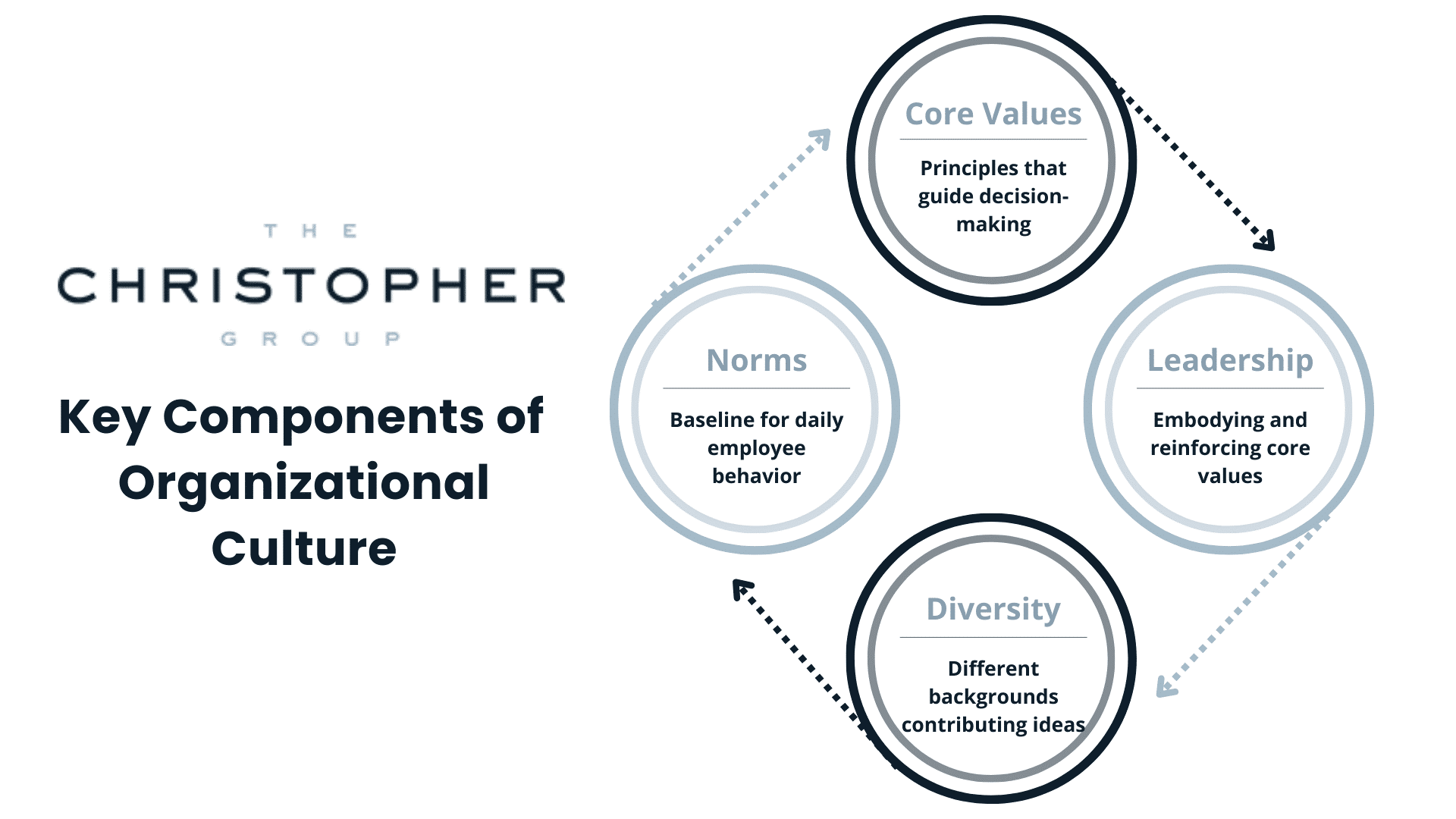
A company’s culture comprises various elements, including core values, leadership, diversity, and norms. These characteristics establish a foundation for employee behaviour and interaction.
Calmere house case study
Calmere House has witnessed a strong shift in culture since the takeover from Chaffinch Group, as the values, leadership, and norms adopted are relatively opposite to what had been in place before. The type of leadership changed from Kirsten’s consultative leadership, where all employees felt strongly included in decision-making, to Kath’s autocratic style, which made staff feel that their contributions and perspectives were no longer appreciated. This, in turn, led to disengagement and dissatisfaction among staff, resulting in high turnover and absenteeism. Additionally, the organisation’s culture shifted from a purely family-oriented to a bureaucratic, profit-driven one. This led to a lack of trust in management, low morale, and resistance to change among employees. This shift is felt even among the residents, who, though they appreciate the renovations, feel that Calmere House no longer takes their individual preferences into account. This shift in culture and employee behaviour is significantly impacting Calmere house’s reputation and profitability as well. To clearly understand how the culture shift is contributing to the organisation’s success and retention, it is important to investigate and apply relevant organisational and human behaviour theories.
Theories/ Models that examine Organisational culture/behaviour
Schein’s organisational culture model
Schein’s model is a three-level framework that explains culture as a multifaceted phenomenon, ranging from visible artefacts to profoundly embedded underlying assumptions (Hattangadi, 2020). Schein’s approach acknowledges the richness and diversity of culture, as well as the ways in which it is influenced by a multitude of factors, including leadership, history, and the external environment. The three levels include artefacts, which are tangible and observable elements; espoused values, which are stated beliefs and objectives; and, lastly, basic underlying assumptions, which are unconscious and taken-for-granted beliefs (Hattangadi, 2020). Leaders can manage organisational culture by effectively understanding these levels.
-
Artifacts and Behaviors
Organisations consist of concrete components, including the arrangement of workstations, the prescribed attire, established customs, symbols, and visible actions (Serra et al., 2019). Artifacts serve as a transparent means for a company to manifest its culture. For instance, the flat structure at Calmere house before the takeover by the Chaffinch group promoted open communication and alignment, as regular meetings and one-on-ones with Kirtsten ensured that all employees were on the same page. The same trickles down to employees, who have a handover meeting after every shift, which has significantly promoted patient care and teamwork.
-
Espoused Values
This pertains to professed values, which encompass the declared standards and perspectives that are discussed and advocated within the company (Serra et al., 2019). Advocated views are commonly conveyed through mission and vision statements, value statements, and other official publications. If a firm prioritises client-centricity, it may place great importance on providing superior customer service (Gerasimov & Ozernov, 2023). For instance, at Calmere house, to ensure cultural fit for recruits, co-workers participated in the selection process, which significantly contributed to the organisation’s retention rate.
-
Basic Underlying Assumptions
The primary layer of Schein’s model comprises essential assumptions. These assumptions are deeply entrenched convictions and deeply rooted attitudes that are often kept silent. They represent the organisation’s fundamental values and influence people’s beliefs, decisions, and behaviors (Serra et al., 2019). For instance, employees at Calmere house always felt part of a family, with onboarding ensuring that recruits understood and empathised with Calmere house’s founding history. Creating a sense of belonging promoted loyalty among the employees.
Analysing Organisational Culture at Calmere house Using Schein’s organisational culture model
Before the transition, Calmere House’s culture was defined by shared values of trust, care, collaboration, and family-like relationships. These values enhanced cooperation and open communication. This led employees to prioritise residents’ wellbeing over strict adherence to procedures, enabling the business to run smoothly under a flat organisational structure.
After the transition, Chaffinch Group changed the entire organisational culture. The artifacts which are the organisational structures, policies, and the channel used in communication, changed to a bureaucratic system with formal procedures and hierarchical reporting mechanisms. The espoused values also changed from personal care and collaboration to standardisation and profitability. This shift made it difficult for employees to cope with the company’s standards and protocols. The company’s rich history faded as employees no longer felt as part of a family but replaceable parts of a machine.
Conclusion and Judgement
According to Schein, when the old and new cultures in an organisation misalign, it usually results in low morale and resistance among the workforce (Manekar, 2024). This was clearly evident at Calmere House, where the long-serving employees chose to leave the organisation, resulting in losses for the organisation. Similarly, the culture shift also affected employees’ productivity and patient-care priorities, with residents feeling the negative shift and many leaving, resulting in lower profits for Chaffinch Group.
Theories/ Models that examine Human behaviour
Maslow’s theory of Human behaviour
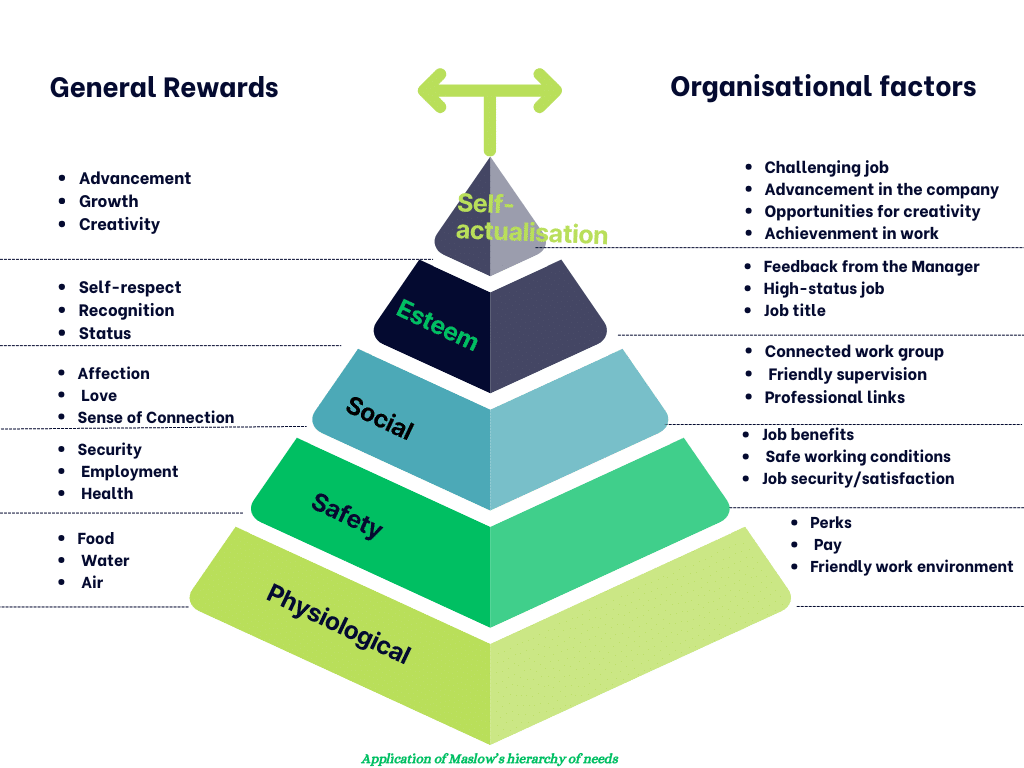
Maslow’s Hierarchy of Needs describes the progression of human motivation through five essential levels: physiological needs, safety, social, esteem, and, lastly, self-actualisation, which is at the top of the hierarchy (Tan et al., 2025). According to the hierarchy, individuals are often driven to satisfy basic needs first, at the bottom of the pyramid, before progressing to more complex needs, as shown in the Image below. Maslow’s hierarchy of needs provides insight into human behaviour, helping executives support staff and create an environment where they can meet their needs at each level, thereby guaranteeing a motivated, ambitious, and satisfied team.
Analysing Employee Behaviour at Calmere house Using Maslow’s human behaviour theory
Kirsten’s leadership at Calmere House satisfied the needs of employees as it provided them with job security, which was a form of safety, stronger work relationships, which satisfied their social needs, and trust and recognition, which satisfied their esteem needs. Under these conditions, most employees achieved self-actualisation, finding true purpose in the provision of care.
However, this balance was made unstable once the transition took place. With Kirsten gone, the person who made the whole team feel like part of the family, these employees felt their needs of love and belonging threatened. It soon proved true, as the safe space once provided to share their thoughts and ideas was closed to them and reduced to a relationship grounded in following what Kath said religiously. The organisational changes and the loss of autonomy automatically became a threat to employees’ security needs. Once turnover began, safety needs were threatened as the workload increased, teamwork decreased, and morale among the remaining employees declined. According to de Wet and van der Lingen (2024), when Maslow’s needs at lower levels are unmet, it usually leads to a lack of motivation, which was experienced after the transition, resulting in high turnover rates and decreased morale among the workforce.
From a human behaviour perspective, Maslow’s theory shows how the new management style interfered with employees’ ability to fulfil higher-level needs. According to Maslow, employees’ needs for belonging and esteem were satisfied through inclusion and close-knit relationships (Rojas et al., 2023). Employees were made to feel valued and part of the house’s success. Chaffinch’s autocratic style eliminated these satisfiers. The employees were less engaged in decision-making, which undermined their sense of belonging. The slight appreciation and reliance on agency employees also contributed to the loss of relatively more esteem, and many employees lived in lower levels of Maslow’s hierarchy (Shi & Lin, 2021). This led to a decline in motivation, more absences, and turnover. In the absence of motivated staff, the quality of care to residents declined, leading to customer dissatisfaction.
How Managers Can use Maslow’s theory to Support Human behaviour
Managers must understand and tackle employees’ circumstances to stimulate desire and job satisfaction (Gerasimov & Ozernov, 2023). Organisations like Chaffinch group must create a favourable performance and job satisfaction environment for their employees by appreciating job safety needs, the need for emotional and social belongingness, reward and recognition, and opportunities for career development. Maslow’s theory serves as a guide for analysing and managing personnel within organisations, where managers should consider that staff’s internal motivators are addressed and employees’ psychological stability is assured.
Maslow’s hierarchy of needs should be considered by leaders when developing plans to meet the requirements and wants of their workforce fully. For instance, basic salary can meet an employee’s basic needs. However, it won’t be enough to make them feel like they belong in the company, boost their self-esteem, or encourage them to pursue self-actualisation (Jonas, 2016). The self-esteem and sense of belonging of employees are greatly enhanced by additional compensation packages that include praise, promotions, and the company’s investment in appropriate training and development, and, in Calmere House’s case, more autonomy and inclusion in decision-making.
Conclusion
By understanding human behaviour through Maslow’s hierarchy of needs, Chaffinch Group’s managers are better positioned to support and foster an enabling environment for employees at Calmere House.