


Description
5DVP Developing Professional Practice Assignment Answers
Our comprehensive 5DVP Developing Professional Practice Assignment Answers will provide you with the precise guidance needed to successfully complete your CIPD 5DVP unit assignment correctly and clearly. These meticulously crafted answers offer a clear roadmap for addressing each assessment criterion, thereby enhancing your learning experience and significantly increasing your chances of passing the unit. Each answer is well-structured and detailed, ensuring that you understand not only what is required but also how to effectively communicate your knowledge. This resource is designed to deepen your comprehension of the 5DVP unit’s key concepts and equip you with the confidence to tackle your assignment with ease.
5DVP (Developing Professional Practice)
5DVP Assignment Task: Questions
5DVP Assignment Answers, knowledge, and understanding will be assessed through written responses to the following questions:.
Activity 1
AC 1.1 Evaluate what it means to be an HR professional, making reference to the CIPD 2018 Profession Map.
A HR specialist should have the knowledge, training, and skills necessary to perform their duties effectively. Professionalism in human resources results from formal education and hands-on experience in people management, as well as a demonstrated commitment to and track record of success in maintaining an impeccable reputation inside the organization. The CIPD (2020) website states that HR professionals should have a firm grasp on the fundamentals of strategic HR management in order to better serve their organizations and help them accomplish their objectives. The CIPD’s 2018 profession map offers an insightful characterization of HR professionalism by outlining the essential qualities and traits of an effective HR expert (Profession map: CIPD Profession map, 2022). The standards of the people profession are formalised in the Profession Map. Hence, People professionals can use the map as a guide to make better choices, take bolder actions, achieve greater results, effect positive change within their organization, and advance in their chosen field (Peters, 2022).
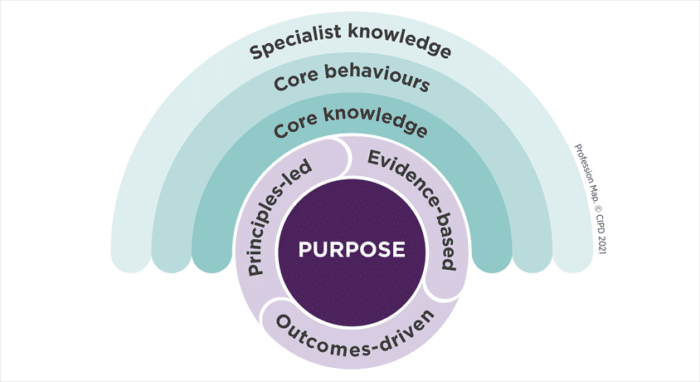
The map flows from core purpose, and core values of people professionals. According to (Profession map: CIPD Profession map, 2022) the core purpose of people professionals is to advocate for enhanced workplace conditions and worker satisfaction. The three core values include decisions, actions and behaviours that are principle-led, evidence-based and outcome-driven.
The map then lays out the core knowledge, core behaviours and specialist knowledge for people professionals. In this case, the map offers transparency and clarity identifying the abilities, knowledge and skills required for each role at every grade level.
Core Knowledge
The professional map identifies six fundamental knowledge domains that are essential for driving change, adding value, and having a positive influence on the workplace. These core knowledge areas include People practice, culture, and behaviour, business acumen, Evidence-based practice, Technology and people and change (Profession map: CIPD Profession map, 2022). The theory supporting the people profession can be summed up in the fundamental knowledge domains, which are based on the most recent research and insights. It lays out what a practitioner in the people professions, regardless of function, industry, or specialty, has to know in order to be effective.
Core Behaviour
A solid basis for sound decision-making is provided by core behaviour domains. The CIPD profession map identifies eight key behaviours that enable people professionals to generate value for clients, employers, communities, and the profession itself. These areas include ethical practice, professional courage and influence, valuing people, working inclusively, commercial drive, passion for learning, insights focused, and situational decision-making (Profession map: CIPD Profession map, 2022). People professionals can always rely on the same set of core behaviours to guide their thinking and actions, no matter how novel or difficult the circumstances.
Specialist Knowledge
Experts in people profession can learn from the specific knowledge areas how to best put their skills to use in the workplace. Specialists’ knowledge covers at least nine areas including learning and development, organisation development and design, people analytics, resourcing, rewards and talent management, diversity and inclusion, employee relations, and experience (Profession map: CIPD Profession map, 2022).
GET FULL 5DVP Assignment Answers: »
Activity 2
AC 1.2 Briefly describe the elements of group dynamics and give at least two examples of conflict resolution methods within an HR context.
Group dynamics, according to Myers (2019), include the intangible behavioural forces that are presumed to have a major impact on the actions of individual team members but which team members themselves are often unable to recognize or control. It’s the dynamics within a team that decide how well they’ll do at accomplishing their goals. In 1965, Bruce Tuckman devised a model widely utilized to describe different aspects of group dynamics from formation to dissolution: forming, storming, norming, performing, and adjourning (Chapman, 2021).
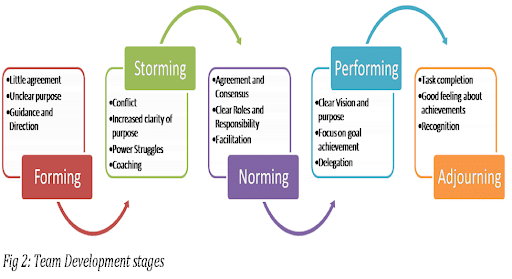
Forming: Individuals work together and put in their best efforts to create an upbeat, cheerful, and respectful environment (Chapman, 2021). Line managers will need to provide substantial advice, as not all duties will have been determined at the outset.
Storming: Disagreements and conflicts break out as boundaries are disputed. When team members are working toward a goal and feeling like they not making any headway, seeking out advice from the line manager might help immensely (Chad, 2013).
Norming: Members of the team begin to put their differences aside, recognize and value one another’s contributions, and show respect for the leader’s position (Chad, 2013). There will be overlap between the forming and storming stages when additional tasks need to be taken on.
Performing: The team’s effort is clearly visible. When members of a team feel comfortable delegating to one another, their manager is more likely to assign more responsibility. Most issues are either avoided or resolved as soon as they arise (Chapman, 2021).
Adjourning: After a project has been finished, the team should celebrate their success. Uncertainty for individuals on the team might result from a lack of group structure after extended periods of hard effort (Chad, 2013).
My company’s experience building a virtual team in response to the COVID-19 epidemic and the resulting requirement for business continuity provide a striking example of these phases in action. HR was crucial in helping my company build a virtual team by pointing people in the right path. As time went on, factions formed within the wider team effort, driven by established personal ties and bonds. During this time period, HR played a crucial role in fostering an atmosphere of cross-departmental cooperation and information sharing as well as improving performance feedback and rules for employee involvement for the virtual team effort. When the virtual team finally reached the norming phase, HR noticed a big improvement in the team’s ability to achieve decisions through group consensus. Over time, the team demonstrated increased independence; while differences of opinion persisted about how to address issues like work hours and methods of communication, these were ultimately settled with minimal involvement from HR and upper management. When the team purpose was accomplished, it was disbanded.
Conflict resolution methods within an HR context
Due to the collaborative nature of most business tasks, personality clashes among employees are inevitable. Management, human resources, and employees all need to be equipped with the knowledge and skills necessary to deal with conflict in the workplace (CIPD, 2020). Dispute resolution methods include, for instance, the negotiating approach developed by Fisher and Ury and the compromise conflict resolution approach. Taking a hypothetical scenario in an organisation where a male and female employee gets into a heated dispute. According to the female employee, the male employee, who is in supervisory position, always disregards her contribution to ideas, and always interrupts when she tries to put her ideas across. The female feels she gets this kind of treatment because she is a woman as it does not happen to other male colleagues.
The Compromising Conflict Resolution Approach
The Thomas-Kilmann concept of compromising conflict resolution includes having a conversation about the situation in question between the conflicting parties (Kilmann, 2019). Any attempt at amicable resolution of a disagreement depends on the dedication and cooperation of the warring parties (Day, 2019). Ideally, the parties involved in the conflict would talk things over and come to an understanding about how to end the conflict once and for all.
Applying the compromising conflict resolution approach, both party’s perspective must be placed into contribution. Hoping that each party is willing to resolve the issue, some underlying issues I may uncover is that the male may have had a hard time taking the female’s input as it was the first time placing a woman on the team and this might be impacting his judgement. A solid ground can be established by allowing the female to explain some of her contributions and the supervisor offering a listening ear and offering honest feedback without bias.
Fisher and Ury’s Negotiation Method
Fisher and Ury agree that in order to find a workable resolution, it is necessary to take into account all of the factors contributing to the disagreement. Fisher and Ury provide context-specific negotiation guidelines that can be applied as appropriate to the type of conflict at hand (Verhun and Cherneha, 2021). Taking the personalities out of the equation, putting interests ahead of positions, coming up with creative solutions that benefit everyone involved, and using objective negotiation criteria are all essential steps.
Using Fisher’s and Ury’s approach to solve the same issue, then first I will have both parties together in a room where each party can openly communicate their concern in an engaging manner. Together we can then assess how the supervisor’s behaviour may impact the workplace environment not just for the female employee but other employees as well. Then we can all look at actionable measures instead of focusing judgment considering a solution that will have a mutual gain for both. Finally each individual would be expected to abide by the set conflict resolution guidelines presented.
Activity 3
AC 2.1, 2.2 Provide evidence of using project management and problem-solving techniques in the course of the project.
Practitioners in the people practice perform a number of tasks necessary to the management of a project. Let’s assume that I’m part of a team at ABC Company tasked with developing a market-based pay structure for the Recruitment and Selection Department where I work as a Human Resources professional. To help the company remain competitive, I will be a part of a salary review committee. Initiation, planning, execution, and business monitoring are the phases of project management that apply to this process and will ensure a successful outcome (D’Souza, 2020). A Gantt chart during the planning phase, and a dashboard specifically for managing projects, are two methods I can use to get things done.
A project management dashboard is an informational interface that compiles key performance indicators (KPIs) relevant to a given project or strategy into a single spot for easy monitoring and analysis (Alam, 2019). This dashboard would serve as a means of communication and team cohesiveness by giving everyone on the team more visibility into their own roles and responsibilities. It will also foster cooperation by centralizing insight data on the project’s progress and keeping everyone abreast of its scheduling and progress. What would appear on the dashboard is illustrated below.


Gantt chart
The key advantages of using a Gantt chart are that they are useful planning tools that help project executors to estimate how long a project will take, what materials will be needed, and what sequence tasks will be completed in (Alam, 2019). This instrument will guarantee that reviews were conducted efficiently and that workers were happy with the results. You can see a sample Gantt chart like the one used in the table below.

Problem solving techniques
During the implementation phase, I may need to research regional compensation data and trends in the industrial reward sector. Some of this data might be available online, but it might be difficult to track down specifics about the organization’s primary rivals, and some of it might already be out of date. The Five Whys and the Failure Mode and Effects Analysis are two possible problem-solving strategies (FMEA) i can employ to solve this issue.
The Five Whys
The goal of this method of problem solving is to identify the underlying causes of the issue at hand. If we question “why?” at least five times, we’ll get to the bottom of whatever’s causing the trouble we’re experiencing (Voehl, 2016). The method was suitable because it helped us assert the emerging rewards market trends and formulate the most appropriate rates employed for the salary evaluation process, thereby resolving the issues associated with acquiring accurate market information on compensation in order to benchmark the salary review and evaluation within the company.
The Failure Mode and Effects Analysis (FMEA)
Known as a standard technique for analysing processes, FMEA is a methodical approach to finding any and all flaws in a product’s design, production, or assembly (Kim & Zuo, 2018). Using this strategy will help us determine where in our research and benchmarking we were most likely to have missed important information. The procedure will also help us determine how to enhance the information we already have so that it is sufficient to meet the benchmarking requirements.
AC 2.3 Explain how you successfully persuaded and negotiated with others in the course of the project (or other related activity).
Persuasion is the process of influencing others by providing a justification for why or why not they should pursue a specific course of action (Doyle, 2020). For persuasion to be successful, effective communication skills are essential. Additionally crucial to persuasion are logical reasoning and problem-solving skills. During the project’s implementation, persuasion will be used to evaluate the needs of the organization, highlight the advantages of compensation evaluations, address any potential objections voiced by senior managers, and identify common ground for the benefit of the organisation as a whole.
A negotiation is a form of bargaining in which two or more parties attempt to divide up a pot of resources. One can negotiate either verbally or in writing. For the project life cycle, the RADPAC negotiating model can act as a essential tool. Establishing a common ground, assessing the problem, discussing possible courses of action, offering a proposal, and finally achieving an agreement are all steps in this methodology (Matz, 2015). The budget for salary reviews will be negotiated, and the reasons for agreeing on a certain number outlined. When all sides to the negotiation are happy with the outcome, it is termed a success.
Being influential means you can persuade others to see things your way while still respecting and valuing their perspective. Depending on the context, influence can have profoundly beneficial, negative, neutral, or even irreversible effects. Human resources professionals need to be persuasive communicators who can rally the troops to accomplish the company’s goals. To cement the company’s position as an employer of choice and provide it a competitive edge, it was crucial to sway the decision of top management over the percentage rise that would be made during the wage review.
Activity 4
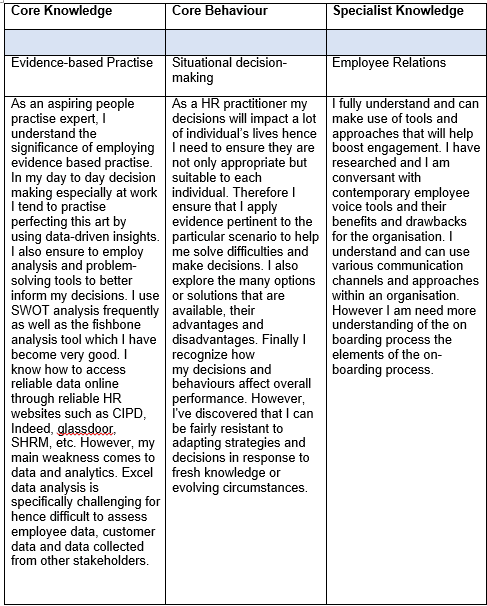
AC 3.1 Undertake a self-assessment of your practice against selected areas of the CIPD 2018 Profession Map (i.e., at least one area of core knowledge, one area of specialist knowledge, and one core behaviour (all at the associate or member level)) or other (e.g., organisational) specifications. Identify your professional development needs in that area and the options to address them.
SELF ASSESSMENT

AC 3.2 Produce a professional development plan (PDP) to meet your professional development needs, which includes a justification of the option(s) chosen.

During AC 3.3 during your programme, provide a reflective summary of your performance against the plan. You should also identify any future development needs and record them in your PDP.
In my Professional Development Plan I mainly highlighted the three areas that I felt I was weak in as per my self-assessment. These areas mainly included the decision making process in my role as a HR although my specialization area focused on on-boarding. These areas are of high interest to my development as I understand my actions and decisions in these three areas can highly impact my effectiveness in the success of my organisation as well as the relevance of my role in my organisation. Through my professional development, I was able to understand data analytics and its significance in informing decisions. I put this knowledge to practise by analysing unemployment trends in the UK especially after the impacts of Covid-19 and Brexit. With the information obtained I was able to contribute information to my organisation in regards to the shifts in labour market, the salary and compensations and factors that impact the organisations in becoming employers of choice. This information was particularly effective in the on-boarding process at my organisation. My plan was quite effective in not only improving my knowledge but its applicability as well. In future however, I feel the need to incorporate more formal learning means such as seminars or courses. I found that enrolling for a short course in Excel was most effective in learning the tool.


Reviews
There are no reviews yet.