
Emerging Trends in the Types of Conflicts and Industrial Sanctions
Shorter and More Strategically Planned Strikes
Another relatively new trend is an increasing frequency of much shorter but well-coordinated strikes. While industrial action was characterized mainly by long-drawn industrial action, today, the more common and effective kind of industrial action is mini-strikes, which are short and intended to cause as much disruption as possible without a high expenditure of resources (Brill, 2023). These strikes target certain business hours or crucial operations to compel employers to negotiate.

Despite a reduction in union membership, businesses in the UK have recently spend time and money as a result of large interruptions caused by more frequent, shorter strikes (Lyydon, 2021). These labour disputes give the harm done to service consumers more weight than the number of participants or the number of days lost, making the monitoring, analysis, and management of strike activities more challenging (Clarke, 2023).
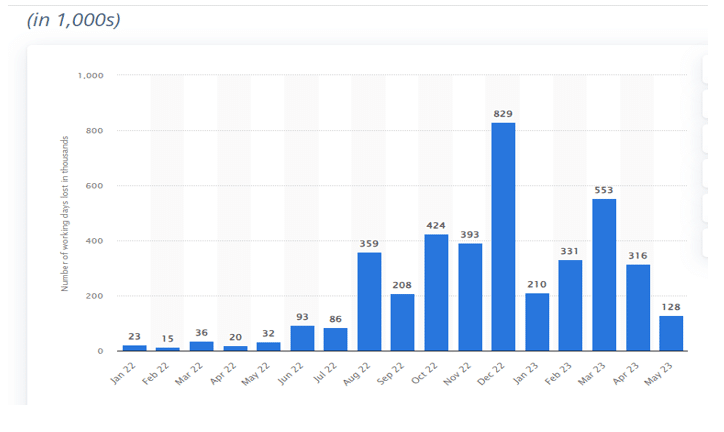
Since the summer of 2022, there have been more days lost to work as a result of labour conflicts. From June 2022 (93,000 missing days) through November 2022 (461,000 missing days) to December 2022 (843,000 missing days), according to Clarke (2023), there was an 83% increase. These strikes have had a considerable impact, changing both employees’ and students’ daily schedules.
For instance, a one-day strike in transport or retail sectors, especially during holidays like Christmas, can hamper the business and compel the firm to change its decision. This trend is particularly in agreement with the newer and more strategic industrial strategies where unions and workers decide on the time and period of strikes to garner as much bargaining power against the employers without necessarily compromising on the wages they earn.

Number of working days lost due to labor disputes in the United Kingdom from January 2022 to May 2023
The Role of Social Media in Conflict
Social media’s ability to alter workplace conflict is another new trend. It has developed into a potent instrument for coordinating, organising, and increasing awareness of workplace challenges (Thomson Reuters, 2023). In the UK, unions and workers have adopted social media platforms to voice complaints, rally support, and pressure businesses. For instance, we have witnessed effective social media initiatives, such as the hashtag #FairPayNow, which attracted much attention and sparked debates among the general public regarding salary disparity.
However, businesses in the UK are also using social media to share their viewpoints, interact with stakeholders, and control their public image when disputes arise. They could explain their side of the story, dispel myths, or give updates on the discussions. It is crucial to remember that the influence of social media may be unanticipated and quick, which might result in hazards. The problems brought on by social media’s viral nature include misinformation, emotional amplification, and a polarised society.

Use of Injunctions
Firms utilise injunctions to stop detrimental industrial action, including strikes, picketing, legal claims, and lockouts, according to Berryman & McDermott-Berryman, 2020. To protect themselves from the effects of strikes, businesses take precautions. Usually, this is done by the employer submitting an injunction application to the High Court prior to the threatened industrial action. By preventing property damage and disciplinary action for illegal picketing, injunctions granted under the Industrial Relations Act shield companies against illegal conduct by individuals or trade unions. Serious consequences may result from a contempt of court ruling for disobeying an injunction. For instance an injunction ordered by the high court on April 27th, 2023, stopped the NHS strike in its tracks (RNC, 2023) and prevented the nurses from taking any further action.